
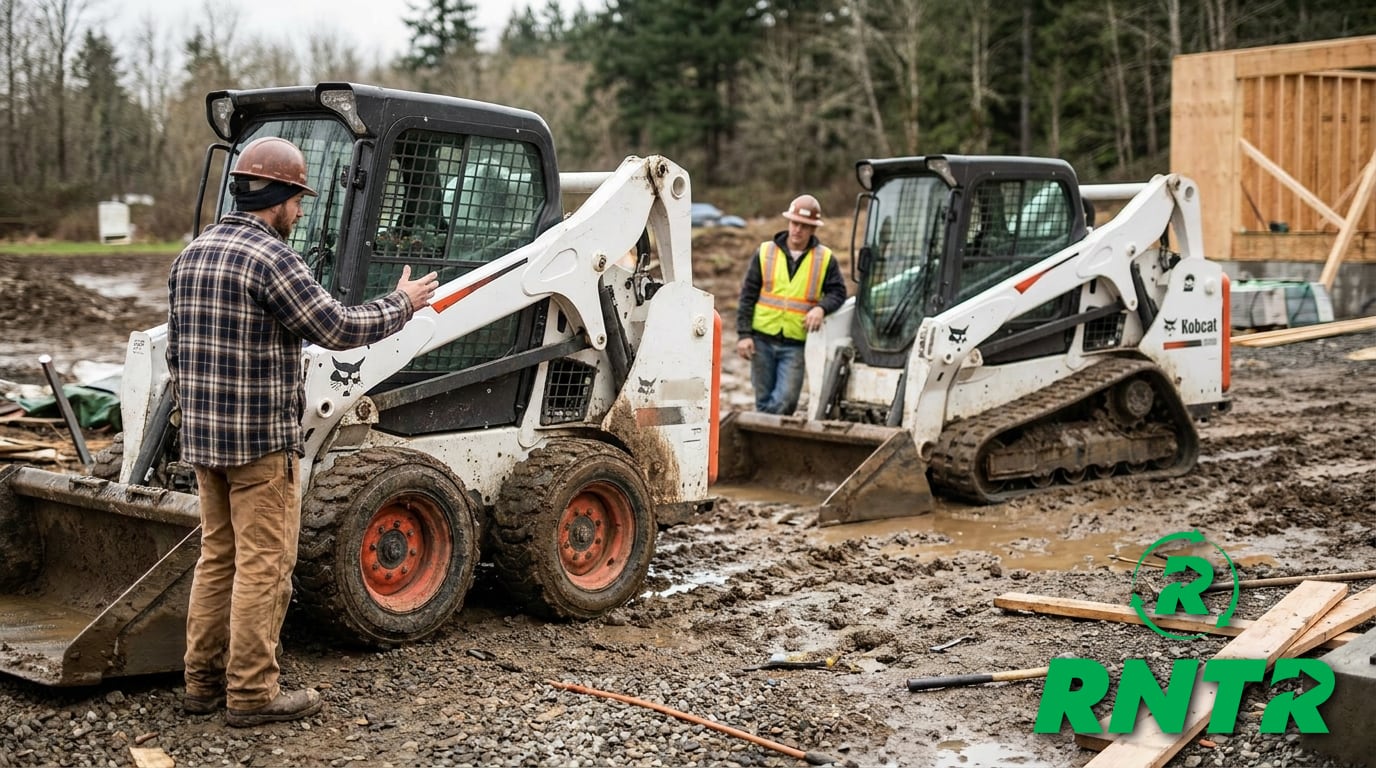
Understand the real differences before you rent the wrong machine for your job site.
Both machines look nearly identical at a glance, and they share the same operator cab and attachment system. But a skid steer and a compact track loader perform very differently depending on your terrain, ground conditions, and project type. This guide breaks down exactly what sets them apart so you can rent with confidence and get the right machine the first time.
Common Rental Questions About Skid Steers and Compact Track Loaders
- How much does it cost to rent a skid steer per day?
- Skid steer rental rates typically range from $250 to $450 per day depending on the machine size, your location, and the rental provider. Weekly rates generally run $900 to $1,500. Compact track loaders rent for slightly more, often $350 to $550 per day, because of the added cost in their undercarriage systems.
- Can I rent a skid steer without a CDL or special license?
- In most cases, yes. Skid steers and compact track loaders are not road vehicles, so no CDL is required to operate them on a private job site. Most rental providers will ask you to sign a liability waiver and may offer a brief orientation. Delivery to your site by the rental shop is common if you do not have a trailer to haul the machine.
- Do rental providers deliver skid steers and compact track loaders?
- Many local rental providers offer delivery and pickup services for an additional fee, typically ranging from $100 to $300 depending on distance. Since both machines usually require a flatbed trailer or lowboy for transport, delivery can be a convenient option. Availability and pricing may vary by provider, so check with your local rental company or browse options on Rntr.
- How long do most people rent a skid steer or compact track loader?
- Most homeowners and small contractors rent for one to three days for projects like grading, demolition cleanup, or landscaping. Larger projects such as foundation work or prolonged site clearing often call for a weekly rental. Some providers also offer monthly rates for extended jobs.
- Is a deposit required to rent a compact track loader?
- Yes. Because of the high value of this equipment, most rental providers require a security deposit ranging from $500 to $1,500, often charged to a credit card. The deposit is returned when the machine comes back undamaged and on time. Always ask about damage waiver options when booking.
- What attachments can I get with a rented skid steer or compact track loader?
- Most rental providers offer a standard bucket with the machine and may have additional attachments available to rent separately, including augers, grapple buckets, trenchers, pallet forks, and brush cutters. Attachment availability varies by shop, so confirm what is in stock when you book.
- Which is better for a soft or muddy yard, a skid steer or a compact track loader?
- A compact track loader is the clear choice for soft, wet, or muddy ground. Its rubber tracks distribute weight over a much larger footprint, reducing ground pressure and preventing the machine from sinking or tearing up turf. A wheeled skid steer will dig in and cause significant damage to soft ground.
The Core Difference: Wheels vs. Tracks
This distinction has a cascading effect on nearly every aspect of performance. Ground pressure, traction, surface damage, speed, maintenance cost, and the types of terrain each machine handles well all trace back to this single design choice.
Skid steers move by skidding their tires across the surface, which is how they got their name. To turn, the left-side wheels and right-side wheels are driven at different speeds, causing the machine to pivot. This works well on hard, stable surfaces but tears up soft ground and turf.
Compact track loaders use the same steering principle, but the tracks spread the machine's weight across a much larger contact area. A typical compact track loader exerts around 4 to 6 psi of ground pressure, compared to 25 to 35 psi for a wheeled skid steer. That difference matters enormously on lawns, muddy job sites, and sensitive surfaces.
When to Rent a Skid Steer
Common skid steer rental use cases include:
- Demolition cleanup on concrete or gravel pads
- Moving materials on a construction site with solid ground
- Loading and unloading heavy materials with pallet forks
- Grading a gravel driveway
- Indoor work such as barn cleanouts or warehouse projects (smaller models fit through standard doors)
Skid steers are also generally faster on hard ground and easier to transport because they are slightly lighter. Rental rates are lower, making them the cost-effective choice when terrain is not a concern.
For reference, a mid-size skid steer like a Bobcat S76 or a Caterpillar 262D3 has an operating capacity of roughly 2,100 to 2,700 lbs and a 68 to 74 horsepower engine. These are practical machines for a wide range of rental jobs.
When to Rent a Compact Track Loader
Common compact track loader rental use cases include:
- Landscaping and grading on residential lawns where turf damage must be minimized
- Site prep and excavation in wet or clay-heavy soil
- Hillside or sloped terrain work where traction is critical
- Erosion control and drainage projects
- Agricultural applications in fields or pastures
- Any project coming right after rain or in consistently wet climates
Popular compact track loader models in the rental market include the Bobcat T76, the Caterpillar 299D3, and the John Deere 333G. These machines typically offer 90 to 100 horsepower and rated operating capacities of 3,200 to 3,600 lbs, making them heavier and more capable than most mid-size skid steers.
One important note: compact track loaders require more maintenance because rubber tracks wear, stretch, and can de-track if improperly operated. Rental providers inspect tracks carefully on return, so operating the machine correctly matters for getting your deposit back.
Size Classes: Mini, Mid-Size, and Full-Size
Mini or compact models (sometimes called mini skid steers or mini track loaders) are walk-behind or ride-on units that weigh under 2,000 lbs. The Caterpillar 299 mini series and the Toro Dingo are examples. These are useful for jobs in tight spaces, small yards, or projects requiring a machine that fits through a fence gate. Rental rates for mini units start around $150 to $250 per day.
Mid-size machines are the most commonly rented class, with operating capacities between 1,700 and 2,700 lbs. This covers the majority of homeowner and small contractor projects. Rental rates typically land in the $250 to $450 range per day for skid steers and $350 to $550 for compact track loaders in this class.
Full-size or large-frame machines offer operating capacities above 3,000 lbs and are geared toward commercial contractors doing heavy site work. These command daily rental rates of $500 to $800 or more and are less commonly needed for residential projects.
When searching for rentals, you may see listings that reference specific manufacturer model lines. Caterpillar skid steer models include the 226E3, 242D3, 262D3, and 272D3. Cat compact track loader models include the 239D3, 249D3, 259D3, 279D3, and 299D3. Bobcat, John Deere, and Case also have comparable model ranges available through local rental providers.
Skid Steer vs. Compact Track Loader: Side-by-Side Comparison
Use this table to quickly assess which machine fits your rental needs based on the factors that matter most for your project.
| Feature | Skid Steer (Wheeled) | Compact Track Loader |
|---|---|---|
| Ground Contact | Four rubber tires | Two continuous rubber tracks |
| Ground Pressure | 25 to 35 psi (higher impact) | 4 to 6 psi (lower impact) |
| Best Terrain | Hard, flat, compacted surfaces | Soft, muddy, sloped, or uneven ground |
| Turf Damage | High on soft ground | Minimal, suitable for lawns |
| Traction in Mud | Poor | Excellent |
| Typical Daily Rental Rate | $250 to $450 | $350 to $550 |
| Typical Weekly Rental Rate | $900 to $1,500 | $1,200 to $2,000 |
| Transport Weight | Lighter, easier to trailer | Heavier, requires larger trailer |
| Maintenance Complexity | Lower (tires vs. tracks) | Higher (tracks require more care) |
| Speed on Hard Ground | Faster | Slower |
| Attachment Compatibility | Universal quick attach (most brands) | Universal quick attach (most brands) |
| Common Uses | Demo cleanup, gravel work, loading materials | Landscaping, wet site prep, sloped terrain |
| Example Models | Cat 262D3, Bobcat S76, JD 332G | Cat 299D3, Bobcat T76, JD 333G |
Attachments: Both Machines Work the Same Way
- Buckets (general purpose, rock, light material)
- Grapple buckets for brush, debris, and demolition material
- Pallet forks for moving pallets and lumber
- Augers for drilling fence posts or footings
- Trenchers for utility lines or irrigation
- Brush cutters and rotary cutters
- Hydraulic breakers for concrete or asphalt
- Grader blades and land planes
- Snow blowers and snow pushers
When renting, always confirm which attachments the provider has available. Some shops rent attachments as add-ons to the base machine rate. Having the right attachment for your task saves significant time and labor.
What About Mini Skid Steers and Mini Track Loaders?
The Caterpillar 299 mini track loader, the Bobcat MT100, and the Toro Dingo TX series are common examples you may find at rental shops. These are popular for:
- Backyard landscaping where access is limited
- Planting large trees with an auger attachment
- Trenching for irrigation or drainage in confined areas
- Tight commercial spaces like parking lot repairs
Mini versions follow the same wheel-vs-track logic as their larger counterparts. A mini track loader handles soft ground better than a wheeled mini skid steer. Rental rates for mini machines start lower, making them an accessible option for homeowners who need mechanical help on a smaller scale.