
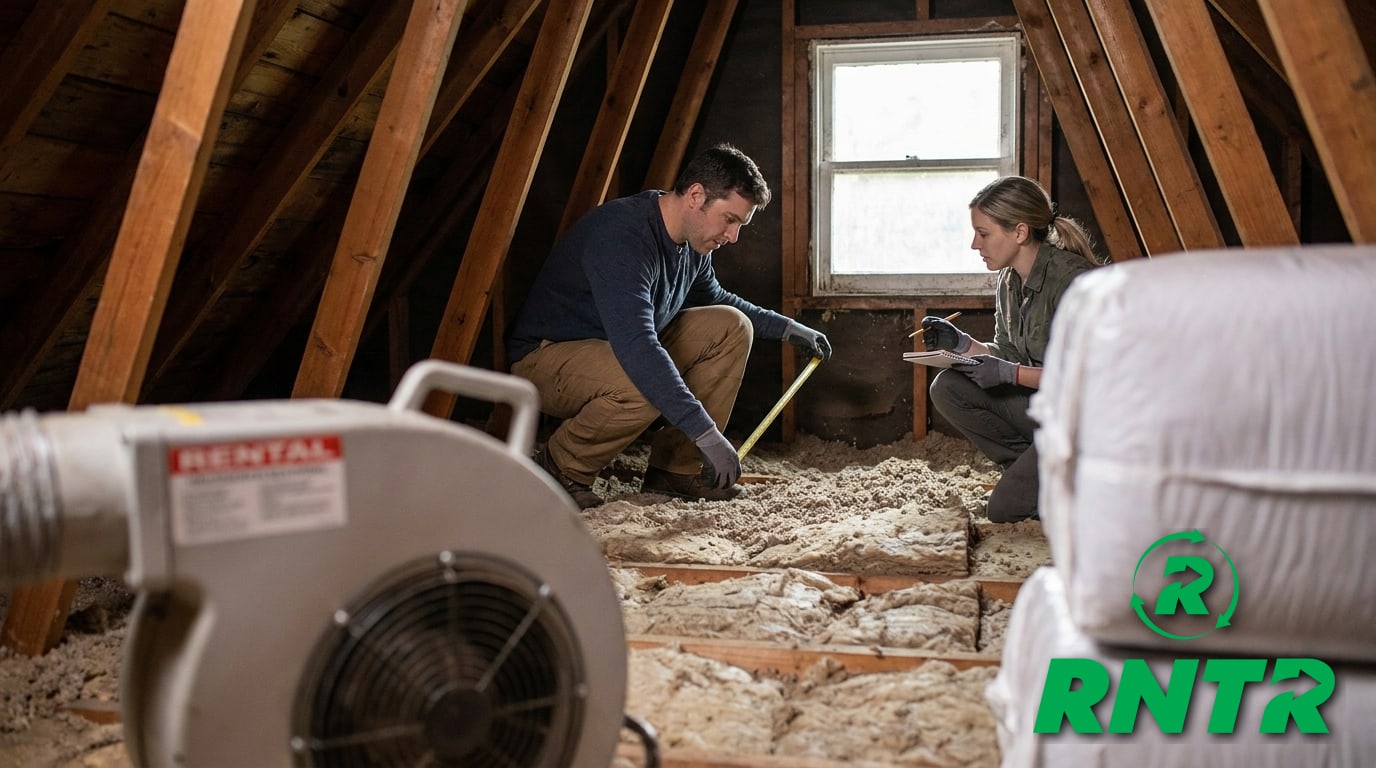
Figure out the right depth, R-value, and bag count before you rent the blower
Adding blown-in insulation is one of the most cost-effective upgrades for an attic, but getting the coverage right depends on a few numbers: your attic's square footage, the R-value you're targeting for your climate, and how deep the material needs to sit once it settles. This guide walks through the math for cellulose and fiberglass loose-fill, plus what it takes to rent an insulation blower and get the job done in a weekend.
Common Questions About Blown-In Insulation Coverage
- How much blown-in insulation do I need for my attic?
- Start with your attic's floor area in square feet, then multiply by the target depth in inches for your desired R-value. Divide that number by the coverage rate printed on the insulation bag (usually listed as square feet per bag at a specific R-value) to get your total bag count. Most calculators build in a 10 percent buffer for uneven joist spacing and settling.
- How deep should blown-in insulation be?
- Depth depends on the R-value you're aiming for and the material. Cellulose typically needs 10 to 12 inches for R-38 and 16 to 18 inches for R-49. Fiberglass loose-fill runs deeper for the same R-value, often 12 to 14 inches for R-38 and 17 to 19 inches for R-49, since it has a lower R-value per inch.
- How many bags of blown-in insulation do I need?
- Bag coverage varies by manufacturer and target R-value, but a common rule of thumb is one bag of cellulose covers roughly 30 to 40 square feet at R-38, while fiberglass bags cover closer to 20 to 30 square feet at the same R-value. Check the coverage chart on your specific bag since density and settling rates differ between brands.
- Can I rent an insulation blower instead of buying one?
- Yes. Most rental yards and equipment shops carry insulation blowers by the day or weekend, which makes far more sense than buying a machine you'll use once or twice. Rental units handle both cellulose and fiberglass, and the hose kits are usually included.
- How much does it cost to rent an insulation blower?
- Daily rates typically run $50 to $100 depending on your area and the machine's hopper size. Some home improvement retailers waive the rental fee if you buy a minimum number of insulation bags there, while independent rental shops charge a flat daily or weekend rate but offer more flexible scheduling.
- Is a deposit required for insulation blower rental?
- Most shops require a refundable deposit, usually in the $50 to $150 range, held against the machine and hose kit. You'll get it back at return as long as the unit isn't damaged and the hopper is reasonably clean.
- How long does it take to blow in attic insulation for an average home?
- For a typical 1,500 square foot attic, expect 2 to 4 hours including setup, hose feeding, and cleanup. Larger attics or homes needing full tear-out and replacement of old insulation will run longer, closer to a full day.
Calculating How Much Blown-In Insulation You Need
Start by measuring your attic floor area, subtracting anything you won't be insulating like storage platforms or mechanical equipment footprints. Then check the Department of Energy's recommended R-value for your climate zone: most northern regions call for R-49 to R-60 in the attic, while milder southern climates often target R-30 to R-38. Colder climates need more depth, which means more bags per square foot.
If you already have some insulation in place, measure its current depth and subtract that from your target depth rather than starting the calculation from zero. Adding 4 inches of new cellulose over 6 inches of existing fiberglass gets you to a different total R-value than starting fresh, so it helps to know both your existing depth and material type before ordering bags.
Blown-In Insulation Depth by R-Value
For R-30, cellulose needs roughly 8 to 9 inches while fiberglass needs 11 to 13 inches. For R-38, cellulose runs 10 to 12 inches against fiberglass at 13 to 15 inches. Stepping up to R-49, cellulose needs about 13 to 15 inches compared to fiberglass at 17 to 19 inches. If your climate zone calls for R-60, cellulose depth climbs to roughly 16 to 18 inches.
Keep in mind that cellulose settles over time, typically losing 15 to 20 percent of its initial loose-fill depth within the first year. Manufacturers account for this in their coverage charts, so always install to the initial fill depth listed on the bag rather than the final settled depth, or you'll end up under-insulated once things compact.
Renting an Insulation Blower for DIY Installation
If your attic access doesn't have a nearby outlet, you'll need an external power source for the blower motor. Many DIYers pair the blower rental with a portable generator rental for the day, especially on job sites without finished electrical near the attic hatch.
Daily rental rates for insulation blowers typically run $50 to $100. Some home improvement stores waive the fee entirely if you buy your insulation bags there, though independent rental shops usually offer more flexibility on pickup times and weekend availability. Expect a refundable deposit in the $50 to $150 range, held against the machine and hose kit.
Pickup is standard since blowers and hose kits are bulky, but some shops offer delivery for an added fee, worth asking about if you're doing a whole-house job. If you're tearing out old, moisture-damaged insulation before adding new material, you'll also want a way to haul the debris away. A dump trailer rental handles that load without turning your truck bed into a mess, and if you're transporting a large quantity of new insulation bags home from the supply store, an enclosed trailer rental keeps everything dry and contained on the drive over.
Tips for Accurate Attic Insulation Coverage
Build in a 10 percent buffer on top of your calculated bag count. Joist spacing, hopper efficiency, and minor spillage all eat into your material faster than the math suggests, and running out mid-job means a second trip to the rental counter.
Check local building code minimums before you buy, since some municipalities require R-values higher than the DOE's general recommendation. It's worth a quick call to your local permit office if you're unsure, particularly for homes being resold or inspected soon after the insulation work.
Blown-In Insulation Coverage Comparison
Coverage rates vary by material and manufacturer, but these ranges give a solid starting point for estimating bags needed per 1,000 square feet at R-38.
| Insulation Type | R-Value per Inch | Depth Needed for R-38 | Coverage per Bag (approx) | Bags per 1,000 sq ft | Avg Cost per Bag |
|---|---|---|---|---|---|
| Loose-Fill Fiberglass | R-2.2 to R-2.7 | 13 to 15 inches | 20 to 30 sq ft | 33 to 50 bags | $15 to $20 |
| Blown Cellulose | R-3.2 to R-3.8 | 10 to 12 inches | 30 to 40 sq ft | 25 to 35 bags | $12 to $18 |
| Mineral Wool (Rock Wool) | R-3.0 to R-3.3 | 11 to 13 inches | 25 to 30 sq ft | 33 to 40 bags | $18 to $25 |