
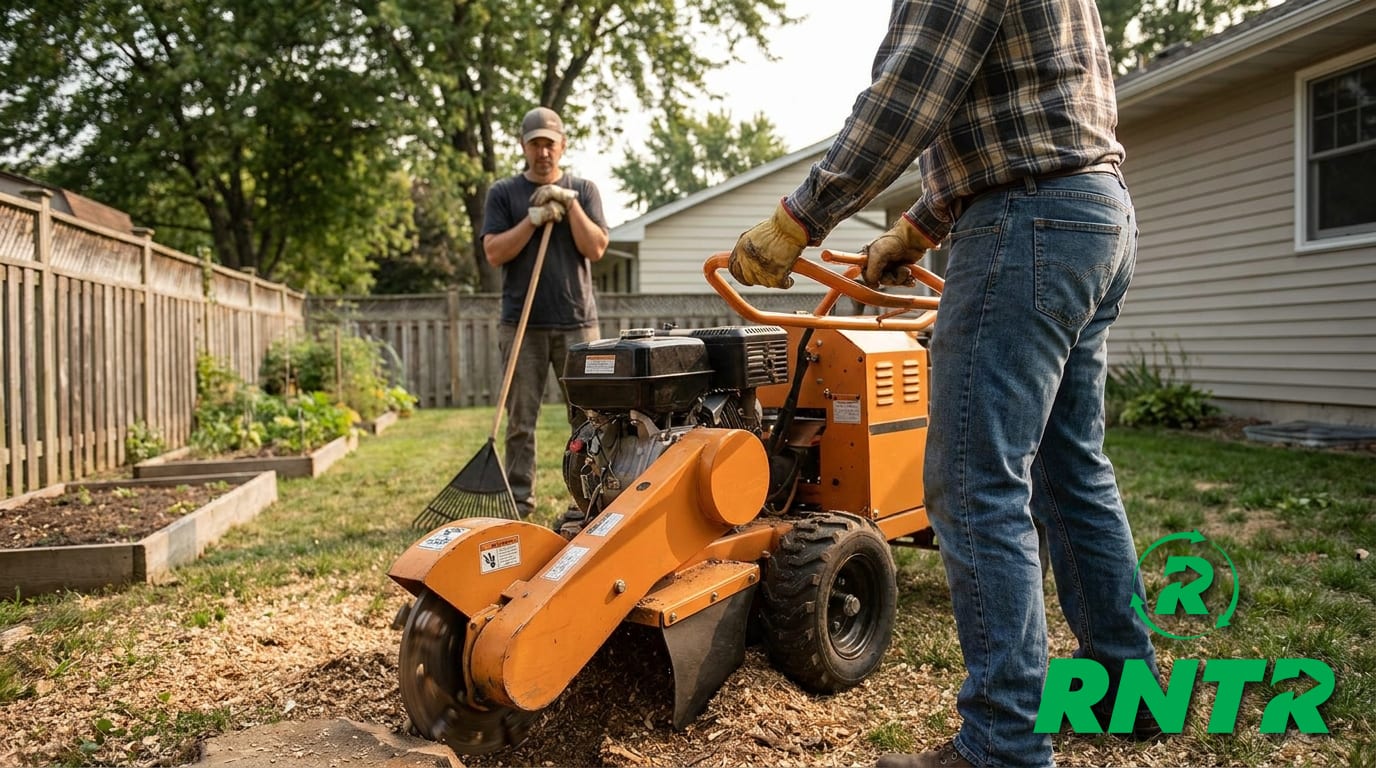
Remove stubborn stumps without buying expensive equipment. Find local stump grinder rentals by the day or week on Rntr.
After a tree comes down, the stump left behind is more than an eyesore. It takes up lawn space, creates a tripping hazard, and can become a home for insects or fungal growth. Renting a stump grinder gives you professional-grade removal capability for a fraction of what it would cost to hire a tree service. This guide covers everything you need before you rent: which machine fits your stump, how much a stump grinder rental costs, how to stay safe on the job, and where to find available equipment near you.
Stump Grinder Rental: Common Questions Answered
- How much does a stump grinder rental cost per day?
- Daily stump grinder rental rates typically range from $175 to $400 depending on the machine size and your location. Small walk-behind units tend to run $175 to $250 per day, while larger self-propelled or tracked models can reach $350 to $400 or more per day. Weekly rates are usually available and offer better value if you have multiple stumps or need extra time to finish the job.
- Do I need any experience to rent and operate a stump grinder?
- No professional license is required to rent a stump grinder for residential use. Most rental providers include a brief operating walkthrough when you pick up the machine. That said, first-time users should review the operator manual, wear proper PPE, and take their time getting comfortable with how the cutting wheel moves. Starting on a smaller or medium stump before tackling a large one is a good approach.
- Can I get a stump grinder delivered, or do I have to pick it up?
- Both options are available through Rntr depending on the local provider. Smaller walk-behind units can often be hauled in a pickup truck or on a small trailer. Larger tracked machines typically require provider delivery or a trailer with a ramp. Check each listing for delivery availability and any additional delivery fees before booking.
- Is a deposit required when renting a stump grinder?
- Most rental providers require a refundable security deposit, commonly ranging from $100 to $300 depending on the machine's value. The deposit covers potential damage to the cutting teeth or other components. Return the machine clean and undamaged and your deposit is refunded in full.
- What size stump grinder do I need for a residential stump?
- For most homeowner stumps under 18 inches in diameter, a walk-behind or self-propelled stump grinder with a 13 to 14-inch cutting wheel is adequate. Stumps 18 to 30 inches across benefit from a mid-size unit in the 31 to 37 horsepower range. Larger stumps, hardwood species, or deep root systems call for a commercial-grade tracked machine to get the job done efficiently.
- How long does it take to grind a stump?
- A typical residential stump 12 to 18 inches in diameter takes roughly 30 minutes to an hour to grind down 6 to 12 inches below grade using a properly sized machine. Larger stumps, denser hardwoods like oak or maple, and stumps with wide root flares take considerably longer. Plan your rental duration conservatively and add buffer time if you have multiple stumps to remove.
- What should I do with the wood chips after grinding?
- The wood chips and sawdust produced by grinding can be raked into the hole as fill material, used as mulch around trees and garden beds, or bagged for compost pickup. Some rental providers include or rent rakes and tarps for cleanup. If you want a smooth lawn over the area, add topsoil over the chips and reseed once the material settles.
Types of Stump Grinders Available to Rent
Walk-Behind Stump Grinders are the most common option for homeowners and small contractors. Machines like the Bluebird SG1314B or comparable belt-driven units have cutting wheels in the 13 to 14-inch range and are powered by single-cylinder gasoline engines. They are compact enough to fit through a standard gate opening (usually 36 inches wide), making them ideal for backyard stumps. These units are manually controlled, which means you pivot and lower the cutting wheel by hand using lever systems. They work well on stumps up to 18 inches in diameter.
Self-Propelled Wheeled Stump Grinders are a step up in both power and convenience. Models in the 31 to 37 horsepower range, such as the Barreto 37SG or Bandit SG-40W, move under their own power and require less physical effort to position. They are still compact enough for most residential yards but grind larger-diameter stumps faster and with less fatigue. These are a good fit for contractors handling multiple stumps or homeowners dealing with large deciduous trees.
Tracked Stump Grinders offer the most stability and grinding power. Units like the Barreto 31 HP track-configured grinder and the Vermeer SC362 use rubber tracks instead of wheels, giving them better traction on slopes, soft ground, and uneven terrain. They are best suited for large-diameter stumps, deep root removal, and commercial or land-clearing applications. Tracked units typically require delivery or a trailer with a loading ramp, so coordinate transport before your rental day.
Towable Stump Grinders are towed behind a truck and positioned over the stump. They tend to be used in professional tree service contexts and are less commonly found on consumer-facing rental platforms, though some specialty rental shops carry them.
For most homeowners, a walk-behind or self-propelled wheeled unit covers the job. If you are managing a larger property cleanup or working with stumps over 24 inches across, consider stepping up to a tracked model. You can browse available stump grinding equipment near you directly on Rntr to compare models and check local inventory.
Stump Grinder Rental Types: Side-by-Side Comparison
Use this overview to match your stump removal project to the right rental equipment type.
| Type | Best For | Typical Horsepower | Stump Size Capacity | Gate Clearance Needed | Avg. Daily Rental Cost | Transport |
|---|---|---|---|---|---|---|
| Walk-Behind | Small to medium residential stumps | 8 to 14 HP | Up to 18 in. | 36 in. minimum | $175 to $250 | Truck bed or small trailer |
| Self-Propelled Wheeled | Medium to large residential stumps, multiple stumps | 31 to 40 HP | Up to 30 in. | 48 in. or more | $250 to $350 | Trailer with ramp or delivery |
| Tracked | Large stumps, slopes, soft or uneven ground | 31 to 50+ HP | 30 in. and up | 60 in. or more | $300 to $400+ | Delivery or heavy-duty trailer |
| Towable | Professional/commercial land clearing | 50+ HP | All sizes | N/A (positioned by vehicle) | $400+ | Towed by full-size truck |
How to Prepare Your Site Before the Rental Starts
Stump Grinder Safety: What to Know Before You Start
Stump Grinder Rental Cost: What Affects Pricing
Machine size and horsepower. Larger, more powerful machines cost more to rent. A walk-behind unit at $175 to $250 per day is the budget-friendly tier. Self-propelled wheeled grinders run $250 to $350 per day. Tracked or commercial-grade units often exceed $350 to $400 per day.
Rental duration. Most providers offer daily and weekly rates. If you need more than two or three days, a weekly rate typically provides meaningful savings. Weekly rates for stump grinders generally run 3 to 4 times the daily rate rather than 7 times, so longer bookings reward you.
Delivery and pickup fees. If you cannot transport the machine yourself, providers may charge a delivery and pickup fee ranging from $50 to $150 or more depending on distance. Factor this into your total rental cost when comparing options.
Deposit. Most providers require a refundable security deposit at pickup. This is returned when the machine comes back undamaged. Ask about the deposit amount upfront so you have the funds ready.
Consumables and damage. Broken cutting teeth are the most common extra charge associated with stump grinder rentals. A single carbide tooth can cost $15 to $40 to replace, and grinding over hidden rocks can break multiple teeth at once. Thorough site prep before you start is the best way to avoid these charges.
Geographic location. Rental rates in high cost-of-living metro areas tend to run higher than in rural markets. Local competition among rental shops also influences pricing. Comparing multiple providers through Rntr lets you see what is available and at what rate in your specific area.
Renting vs. Hiring a Tree Service: Which Makes More Sense?
- You are clearing a large area and have stumps of varying sizes spread across the property
- The stumps are in tight or hard-to-access areas where service trucks cannot maneuver
- You want to control the timeline and grind depth rather than relying on a contractor's schedule
- You are already renting other equipment for a larger landscaping or renovation project